

Blessed are the poor in spirit, for theirs is the kingdom of heaven.
Blessed are those who mourn, for they will be comforted.
Blessed are the meek, for they will inherit the earth.
Blessed are those who hunger and thirst for righteousness, for they will be filled.
(Matthew 5:3-6)
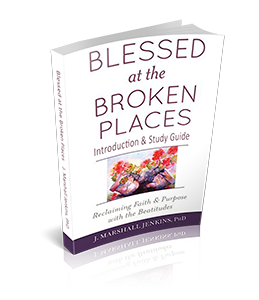
The following is the first of two brief opening reflections for an adult forum on the Beatitudes based on my book, Blessed at the Broken Places: Reclaiming Faith and Purpose With the Beatitudes.
Summary of Receptive/Responsive Beatitudes
J. Marshall Jenkins, Ph.D.
In Matthew’s Gospel, Jesus begins the Sermon on the Mount with eight Beatitudes, or blessings. The first four emphasize receptive/attitudinal qualities. Together they characterize humble openness to God’s grace (receptive). One learns from them attitudes for a life of mutual love with God and neighbor. They also prepare one for action as described in the ensuing four Beatitudes. A summary of the first four Beatitudes and spiritual practices that help with realizing them and maturing in them:
Blessed are the poor in spirit, for theirs is the kingdom of heaven (Mt 5:3).
The poor in spirit are “beggars in spirit.” They recognize their utter and total dependence on God for all things. Its counterpart in Luke simply says, “Blessed are the poor.” If one is not poor, one cannot lose sight of one’s essential affinity with the poor in poverty of spirit. One cannot neglect or exploit the poor and sustain poverty of spirit at the same time. But this will be addressed more fully in the latter four Beatitudes.
The Sermon on the Mount conveys demands that many deem humanly impossible. It seems contrary to salvation by grace alone, not by works. But by beginning the sermon with blessing the poor in spirit, Jesus begins with grace, one’s recognition of it and grateful reception of it. It covers everything one receives, from the air we breathe to corn on the cob to the love of a friend to salvation by the cross. Everything. Every moment presents opportunities to open to the wonder of God’s gratuitousness. Practicing gratitude, therefore, cultivates and deepens poverty of spirit.
In our gratitude for everything, we receive even more: the Kingdom of Heaven. This is not just the sweet bye-and-bye: Jesus taught us to pray for God’s kingdom to come on earth as in heaven. God’s coming and present kingdom is the central theme of Jesus’s ministry. It refers to God’s reign in the individual heart, collective society, and natural order. One can paraphrase the Beatitude, “Blessed are those who recognize that nothing is their own, for they will have it all.”
Many interpreters rightly emphasize humility here, most notably, Augustine. But I respectfully differ with simply equating poverty of spirit and humility. Rather, I see all four of the receptive/attitudinal Beatitudes as dimensions of humility, of which poverty of spirit is a crucial one.
Blessed are those who mourn, for they will be comforted (Mt 5:4).
A long tradition of interpretation views mourning narrowly as contrition for sin. But in modern interpretation a broader approach prevails. It includes contrition, but Jesus clearly offers kingdom power as an answer not only to guilt, but to grief over loss. In scripture, God’s reign as an answer to all grief recurs, culminating in John’s vision of the New Jerusalem in which “God himself will be with them; he will wipe every tear from their eyes. Death will be no more; mourning and crying and pain will be no more, for the first things have passed away” (Rev 21:3b-4).
The straightforwardness of this Beatitude masks the outlandishness of the blessing. The Greek term for mourning here denotes a gut-wrenching, seemingly inconsolable distress. In such intense mourning, comfort seems impossible. Almost as impossible as a resurrection.
This Beatitude most starkly brings out the suffering implicit in all the Beatitudes. Grief is an element of all suffering as we accumulate small losses of hopes and dreams, physical functions and favorite pastimes, and customs and totems that made our world seem secure. This Beatitude invites us to consecrate all of our suffering, therefore, as sharing the sufferings of Christ.
To do that, we must respect our suffering as we respect the suffering of Christ. Then mourning becomes more than a natural grief response: It builds virtue. We can both heal and cultivate the virtue of grieving faithfully by telling our stories to God, a caring companion, and ourselves. Telling stories has the therapeutic effect of reconstructing our narrative broken by losses. The spiritual effect comes as the words and silent pauses in the telling clear our vision of God’s hand at work. In recognizing the connection with God and fellow humans, we find ourselves somehow comforted.
Blessed are the meek, for they will inherit the earth (Mt 5:5).
Blessing the poor in spirit defies our culture’s ideal of self-sufficiency. Blessing those who mourn defies denial of painful feelings. But blessing the meek defies our very speech. For we equate meekness with self-abnegating timidity.
Yet, it has not always been so. Meekness carried a stronger meaning until about the 18th century with the industrial revolution. We hear it and think of Caspar Milquetoast. But Jesus’s audience heard differently.
Blessing the meek was countercultural in Jesus’s time because it empowered the powerless against men of violence and greed who sought to subjugate and exploit them. It remains so today. For meekness is not about a lack of strength but about the gentle use of it. In scripture, it is the disciplined use of strength to restrain violent impulses and channel the energy of anger to peaceful purposes. The meek build up and do not tear down. They absorb violence and refrain from retaliation.
In recent history, the nonviolent resistors of the Civil Rights movement exemplify meekness. I find it especially inspiring to find meekness in others and hold them up as examples. Doing so and developing spiritual disciplines of gentling and willingness as a servant of God and neighbor help us discover and deepen our own meekness.
Blessed are those who hunger and thirst for righteousness, for they will be filled (Mt 5:6).
Jesus does not bless those who seem to have it all figured out but those who hunger and thirst to learn the way. Unable to muster it themselves, they know that their righteousness comes only by God’s grace. Jesus takes it a step further: Because of his righteousness, we become righteous just by wanting it.
But what is righteousness? In scripture it means more than right behavior. Translators use the terms righteousness and justice interchangeably, so they most often interpret hungering and thirsting for righteousness as longing for a just ordering of society. In biblical tradition, that means an order measured by care for the vulnerable. Biblical justice invites affinity with the least powerful because the story of our faith tells of our salvation from slavery, whether to Egypt or to sin and death.
I agree that this Beatitude points in that direction; yet, I say not so fast. The second four Beatitudes will develop the imperative of doing social justice. But I follow a school of interpretation – call it the Pauline school – that says look deeper at justice. In scripture, social justice springs from something deeper. It springs from God’s mercy. We moderns separate justice and mercy, but in the biblical trajectory, mercy is the heart of justice. Therefore, justice begins with God’s love for us, and from that our moral imperative follows to love others. In Paul and Old Testament covenant theology, righteousness means right relationship. Right relationships mean more than the fair ordering of things, important as that is. Right relationships are loving relationships.
So blessed are those who hunger and thirst for loving relationships with God, neighbors, strangers, even enemies. The spiritual crux of this matter lies in the hungering and thirsting, the painful realization that I fall short. But with the promise of being filled means that the hungering and thirsting suffice for Christ to include me among the righteous.
Moreover, if I hunger and thirst for right relationships, then I want to know what to do. I want to discern the will of God and make that my lifestyle. According to Paul and all the mystics after him, our main tool for discerning that is love itself. Love, and God will show you how, step-by-step. Paul sums it up: “May your love overflow with knowledge and full insight, to help you discern what is best, so that on the day of Christ you may be found pure and blameless, having produced a harvest of righteousness that comes through Jesus Christ for the glory and praise of God” (Phil 1:9-11).
Conclusion
So the way of humility, the way that receives God’s love like a little child and cultivates a loving heart begins in gratitude for God’s abundant blessings even – and perhaps especially – in hard times. It moves to honest grief over losses even as it accounts for the abundance, and brings that pain before God with a wild expectation of comfort. From there it finds strength to restrain from temptations to grab power. Instead it maintains willingness to follow God’s way. Hungering and thirsting to learn God’s way and please God fuels this humble love as it keeps an open ear to God’s word in scripture and a loving life. Now strength is being perfected in weakness. Now Christ’s disciples are ready for the mission.
Related Posts
0 Comments