
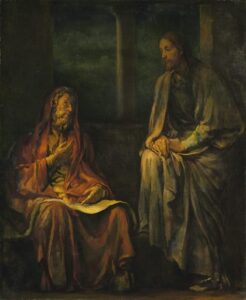
Nicodemus visits Jesus at night.
Now there was a Pharisee named Nicodemus, a leader of the Jews. He came to Jesus by night and said to him, “Rabbi, we know that you are a teacher who has come from God; for no one can do these signs that you do apart from the presence of God.” Jesus answered him, “Very truly, I tell you, no one can see the kingdom of God without being born from above.” Nicodemus said to him, “How can anyone be born after having grown old? Can one enter a second time into the mother’s womb and be born?”
Jesus answered, “Very truly, I tell you, no one can enter the kingdom of God without being born of water and Spirit. What is born of the flesh is flesh, and what is born of the Spirit is spirit. Do not be astonished that I said to you, ‘You must be born from above.’ The wind blows where it chooses, and you hear the sound of it, but you do not know where it comes from or where it goes. So it is with everyone who is born of the Spirit.”
Nicodemus said to him, “How can these things be?” Jesus answered him, “Are you a teacher of Israel, and yet you do not understand these things? Very truly, I tell you, we speak of what we know and testify to what we have seen; yet you do not receive our testimony. If I have told you about earthly things and you do not believe, how can you believe if I tell you about heavenly things? No one has ascended into heaven except the one who descended from heaven, the Son of Man. And just as Moses lifted up the serpent in the wilderness, so must the Son of Man be lifted up, that whoever believes in him may have eternal life.
“For God so loved the world that he gave his only Son, so that everyone who believes in him may not perish but may have eternal life. Indeed, God did not send the Son into the world to condemn the world, but in order that the world might be saved through him.
Those who believe in him are not condemned; but those who do not believe are condemned already, because they have not believed in the name of the only Son of God. And this is the judgment, that the light has come into the world, and people loved darkness rather than light because their deeds were evil. For all who do evil hate the light and do not come to the light, so that their deeds may not be exposed. But those who do what is true come to the light, so that it may be clearly seen that their deeds have been done in God.”
Before Jesus came along, Nicodemus likely enjoyed an impeccable reputation. As a Pharisee, people looked up to him for his holiness and knowledge of the scripture and righteous living, a guide for the perplexed. A leader, Nicodemus exercised political skill in keeping others on the right track as they tried to live in ways pleasing to God while not poking the bear of the occupying Romans. So he held a special appointment to the ruling council called the Sanhedrin, likely due to his leadership and discretion.
Yet, Nicodemus gets a bad rap, at least in the biblical commentaries I read. From the get-go, John reports that, “He came to Jesus by night.” This does not likely endear Nicodemus to the Christian community to whom John writes, given John’s motif of light as goodness and darkness as evil already introduced in the prologue. Nowhere does he state the motif more strongly than in the concluding verses of this story where John states that, “People loved darkness rather than light because their deeds were evil. For all who do evil hate the light and do not come to the light, so that their deeds may not be exposed” (v. 19b-20). We imagine Nicodemus skulking about in the darkness, protected by the very evil that Jesus and his followers oppose.
Indeed, Nicodemus comes confident in his authority to see Jesus for who he is, an authority nobody questions until now. Yet, Jesus does. He takes the learned Nicodemus back to school on how to discern God’s presence and action in the world. He uses imagery of rebirth alien to the customary idiom Nicodemus mastered. Flummoxed, Nicodemus asks an inept question, taking the metaphor about being reborn literally and asking how an old geezer like him can possibly reenter his mother’s womb and come out squalling again. Over against the status and prestige he enjoyed in his context, Nicodemus goes down in history as a spineless buffoon.
Call me stubborn. Call me proud. But I disagree. For I am Nicodemus. Hear my apology in defense of Nicodemus, and if I fail, judge me all the more harshly.
Yes, Nicodemus “came by night.” Well, we can go on and on about the prepositional phrase, “by night,” but what about the verb, “came?” Where are the rest of the Pharisees? The Sanhedrin? Or the disciples for that matter? Much later in the gospel they take cover in the dark of night while Jesus suffers arrest, persecution, and execution. Turning to only a charcoal fire for light on the night of Jesus’s death, Peter denies Jesus three times. Today we honor Peter with one of the world’s most spectacular tombs in a basilica named after him in Vatican City.
Peter, Nicodemus, and I are guilty of taking refuge in the darkness. Like them, I avoid getting caught being a Christian if I think it might cost my business or reputation. Better to talk about my motives in terms of better profits or maximizing pleasure and reducing pain than speaking of a desire to please God. Those I keep precious, intimate secrets for the most part. Moreover, I do not want anyone to mistake me for a fundy or fanatic, I do not want people to misunderstand. But if I keep my primary motive – to love God and neighbor – discreetly hidden behind euphemisms and evasions, can anyone really understand me?
Furthermore, Nicodemus comes on a peace mission. Jesus just cleansed the temple; yet, Nicodemus focuses on the positive, trying to build a bridge for a more cooperative relationship with this Elijah-like prophet. Granted, the Sanhedrin may have sent him as a plant, but that does not fit with the way the story plays out later. When the Sanhedrin plot Jesus’s destruction, Nicodemus speaks up for giving him due process at least, and he faces pushback (7:50-52). (The U.S. desperately needs more with his courage among our legislators today.) After the crucifixion, Nicodemus and Joseph of Arimathea show up before Pilate in the light of day to give Jesus a proper burial (19:38-42).
With nothing to gain and everything to lose, he come out and shows his solidarity with Jesus. That is exactly what Christ calls us to do. We can criticize Nicodemus for failing to leave all his privilege behind to follow Jesus on the dusty roads, but we would be hypocrites. Nicodemus keeps a low profile and works the room on Jesus’s behalf with the Sanhedrin, likely figuring that he could do Jesus more good by maintaining his position and speaking up at the right moment than by getting thrown out. Yes, that strategy offers self-protection as well, and it obviously does not work this time. But who among us can claim a life of witness any less compromised?
Jesus confronts the compromised life of Nicodemus and you and me when he seemingly casts aside Nicodemus’s olive branch and academic credentials and tells him he could not see straight about God without the proper birth. Nicodemus assumes, along with everyone else but Jesus, that the birth that matters was a natural birth into the family of Abraham, marked by male circumcision for good measure. Then you inherit God’s ultimate blessing as long as you keep your nose clean. When judgment day comes, you’re good.
Jesus changes the whole narrative by talking about birth in a different way, birth as a matter of the heart and as an orientation that sees how God reigns in an otherwise godforsaken world. Are you alive now? Forget the inheritance of the past and the glory of the future. Do you enjoy citizenship in God’s kingdom today, for Christ’s sake? If you only live on past promises and future hopes and do not recognize the Son of God sitting right here in the night trying to connect with you, you need another birth, another life.
So Nicodemus claims to see Jesus as “a teacher who had come from God” because of his miraculous “signs” (v.2). And he is not wrong. Jesus confronts not so much what he understands about him as how he thinks he understands. He does not get it right because of his learning of the law that helps him read the tea leaves. Nicodemus gets it right because the Holy Spirit, like a wind that blows where it will, blew upon and through him.
Thus, Jesus cuts Nicodemus off and says, “Very truly, I tell you, no one can see the kingdom of God without being born anothen.” The Greek term, anothen, can mean “again” and “from above.” The Fourth Evangelist majors in double entendre, and I think he means both. Nicodemus interpreted it as “again” and bungled the metaphor. “Again” implies that the birth is a matter of time, of newness, a letting go of the past compromised life and living anew with Christ now. This could mean letting go of a shameful past of drug abuse, sexual license, or any other way to perdition.
But notice that Jesus says this to a man who has no such problems, whose righteousness many take for granted because of his social standing. It is a call to wake up from a false sense of security, take up your cross, and follow him. Birth “by water,” or baptism, enacts this kind of drowning of the old life and rising to the new with Christ.
Of course, we cannot do all that for ourselves. We make a decision, but not a decision to embark on a new program that we cleverly design and implement with our own wits and muscle. Rather, we decide to consent.
That is where the spatial interpretation, “from above,” comes in. You only get anywhere on this quest with the Holy Spirit in your sails; moreover, you even relinquish the rudder to the Holy Spirit. “The wind blows where it chooses, and you hear the sound of it, but you do not know where it comes from or where it goes. So it is with everyone who is born of the Spirit” (v.8). Let me elaborate: So it is that everyone who is born of the Spirit lives a life of prayer, regularly returning to the Spirit with a finger in the wind to sense God’s movement and an open heart willing to follow.
And who is to say that Nicodemus is not already doing that? As noted, he may have come by night, but he comes nonetheless. He responds to Jesus’s signs, and his interpretation – that God sent Jesus – is on the right track if not altogether correct. On that night in his burning curiosity about Jesus, his desire to know him and to learn from him, he sets aside the usual protocol and crosses a line to see his face. By the time he stepped out the door of his comfort zone and into the night, the light of Christ guided him and the wind moved him. Perhaps he was already born anew and from above, unawares. Jesus never told him he was not. He only told him how one comes to see the face Nicodemus beheld that very moment.
So I am Nicodemus, not only in my sins and shortcomings, but in living into this strange, mysterious, and even dangerous life with God to which Christ calls me and through which the Holy Spirit leads me. I muddle along with prayers and occasional dares to trust the Spirit to give me the words to say and the gifts to give back. Occasionally, I show up in Christ’s story, and that story matters to me more than my own. I pray for the Spirit to keep me awake enough to recognize Christ and love him amid the unexpected twists and turns of the journey. And as for reaching out to him in the dark, I have no apologies for that. He meets me there every time.
Related Posts
Truth in the Wind: A Sermon on John 16:12-15
Blessed are the pure in heart, for they will see God. Blessed are the peacemakers, for the will be called children of God (Matthew 5:8-9).
Image: John La Farge, Visit of Nicodemus to Christ, 1880s, Public Domain.
0 Comments