
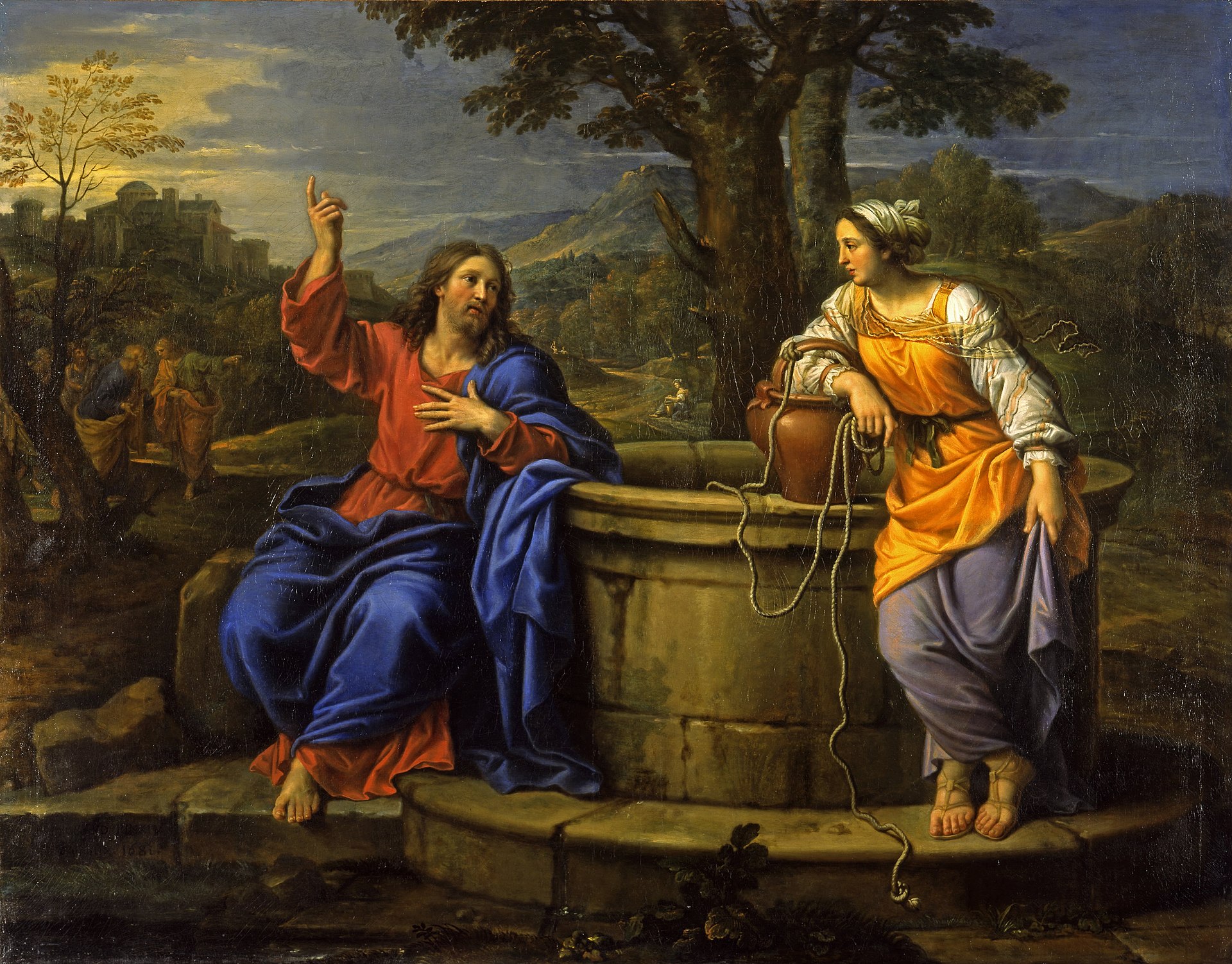
Jesus Sees and Understands
In the middle of an awkward conversation on a hot day by a well, Jesus said to his unnamed conversation partner, “You have had five husbands, and the one you have now is not your husband” (John 4:18). He blew her cover. It sounds like a conversation stopper or worse, a cue for her to throw water in his face and walk off.
Many interpreters through the ages assumed that Jesus called her out for a notorious and illicit sexual career. But that likely says more about the biases of the interpreters. Yes, serial reckless sexual choices could account for multiple husbands, but so could the ancient semitic custom of passing a wife to the brother of the deceased. She could have been widowed by five brothers for all we know.
Or perhaps she survived abuse in her family and did not know the script for marriage unless the husband abused her. So each man chewed her up and spit her out only for another like him to pick her up. Especially in a culture in which women possessed no rights, she had precious little recourse. Yet, even now in our own community, it occurs commonly
Whatever the narrative, Jesus told her he knew she lived a hard life. That was the point. One wonders about the look in his eyes and hers, the sound of his voice. Knowing his heart for the vulnerable, I can only imagine softness. Perhaps that explains her counterintuitive response: Excitement and awe! At last someone saw her and understood!
Choosing Invisibility
For she was, after all, invisible, and quite possibly by her own choosing. With enough abuse and grief, one may choose to protect the ever open wound several ways. One may meet the world with the ferocity of a wounded bear, adopting offense as best defense. One can use seductive charm to use people, a cynical quid pro quo assuming that others always do the same.
Or one can make oneself invisible like the Samaritan woman. In ancient Palestine, women gathered in the cool of the morning with their jars at the well to socialize and perform the heavy work comfortably. Our heroine went in noonday heat, intentionally alone and unseen.
But choosing invisibility entails choosing the lesser evil, a cycle of sadness, anger, and numbness in anonymity to avoid rejection and hurt in community. No defensive strategy for coping with a history of loss and abuse eliminates the need for a witness to one’s life, someone who understands. On this dog day, a Jewish stranger cut through the heat and did just that.
Tired from a long trek through enemy territory, he sat alone by Jacob’s well after sending his disciples away for provisions. He chose a moment of invisibility himself, a break, not a defensive lifestyle. Just a chance to rest alone and regroup from the prophetic work of calling disciples, performing a miracle at a wedding, driving out the merchants from the temple, and trying to explain himself to a well-meaning but dense Pharisee named Nicodemus. Always on the move, always teaching people who did not get it, he surprised the Samaritan woman and perhaps even himself with his request for water.
This startled her because the invisibility routine did not work with him. Moreover, he seemed an unlikely candidate to see her. For not only did men not converse with women in such places, but Jews and Samaritans did not associate with each other.
Living Water For Jew and Samaritan
How did the Samaritans offend the Jews? Samaritans descended from the ten northern tribes of Israel defeated by Assyria a century and half before the fall of Judah, the home of Judaism. They intermarried with non-Israelites and allowed pagan worship, rendering them impure imposters to the Jewish mind. But when Alexander the Great built a temple for them to rival the temple in Jerusalem, the nationalistic rivalry intensified.
To this nationalism the Samaritan woman turned when she needed an identity. She did not need an identity when invisible, but now she grabbed what she could, something obvious. Taking a route common to us today, she resorted to political rivalry, playing the belonging game of identifying with her group as opposed to his. She demanded, “How is it that you, a Jew, ask a drink of me, a woman of Samaria?” (v.9).
Jesus refused to play that belonging game. He said this was not really about her giving water to him but him giving better water to her, living water that quenches thirst for belonging with the God of all regardless of tribe or nation. To a woman suspicious of Jews and likely of men in general, he offered himself not to exploit her but to fulfill her deepest hopes. At first she did not get it, at least not theologically, but practically speaking, she got on the right track. Incorrectly, she thought he promised some new technology to provide abundant water without the daily haul of a heavy jug. But she got this right: She could trust him. He offered real hope.
Beyond Nationalism
Yet, she needed another minute to let go of the Samaritan versus Jew national belonging game. She pointed out that he asked for a drink at Jacob’s well, a sacred place in Samaria, not Judah. She pressed harder, “Our ancestors worshiped on this mountain, but you say that the place where people must worship is in Jerusalem” (v.20), perhaps goading for a spar or hoping for a concession. He gave neither. He held his ground on salvation coming through the Jews. But he dismissed territorial claims based on the past. Rather, he reframed the issue to salvation’s future, indeed, its present in the form of a thirsty Jew who crossed the border into her country, who saw her and took her seriously.
A great irony of the Bible is that it records the history of a politically failing nation through which the good news of salvation comes anyway. Nationalism never did God or the chosen people much good. God warned as much through the prophet Samuel when they first pleaded for a king like those of the other nations. But the prophets used national rulers as foils to show how the foolishness and weakness of God is wiser than the cunning and strength of kings, to paraphrase the Apostle Paul (1 Cor 1:20-25).
Here by Jacob’s well in hostile Samaria with a forbidden conversation partner, Jesus brushed nationalistic hopes aside as he would time and again in his ministry of salvation for the whole world without boundaries, salvation through him. Jesus consigned nationalism to irrelevance for all time. To this day, any nationalism that claims his name takes his name in vain.
Setting the Samaritan Woman Free
He got the Samaritan woman to the real point, the real power: love. By his love, he inspired her to break out of her invisibility and become a light to the world herself. “I know the Messiah is coming,” she said, and although the Samaritan messianic narrative differed in details from the Jewish one, he acknowledged that Samaritan and Jew and all the world shared the same hope. “I am he, the one who is speaking to you” he answered, no longer invisible himself.
If he had not listened and known her I suspect she would have written him off as another man with a line. But leaving the water jug in haste or in confidence that she now had all the living water she needed, she ran into town. Invisible no more, she sang out the word that a man saw her and knew her as only a prophet could. With such contagious excitement, she emerged from anonymity and inspired heretofore suspicious neighbors to run back with her to see.
When Jesus said, “I am he, the one who is speaking to you,” he used the “I am” God answered when Moses asked God’s name. By the power of that name, Moses assisted God in setting the slave nation Israel free. In John’s Gospel, Jesus used that identifier several times, but first with this outsider to set her and her people free. When his insider disciples returned and saw him talking with her, it scandalized them. Jesus taught them a short class on evangelism, using the imagery of planters, reapers, and abundance.
As Jesus taught, the Samaritan woman showed them how. As the disciples listened in muteness, she ran to town and sang. The Samaritan community believed and welcomed him and his dumbfounded disciples to visit longer.
Peacemaker and Witness
Jesus and the Samaritans made peace, thanks to the witness of this once invisible woman. The essence of peacemaking in the New Testament is not courtesy or avoiding conflict. Do not get me wrong: Civility and nonviolence help tremendously, and we need more of both. Desperately. But the essence of peacemaking is breaking down walls and building bridges, forgiving old rivalries and welcoming the foreigner, listening to the invisible until beauty comes to light.
This is not merely a partisan tenet for political left-wingers. This is the Word of God shot through scripture. Almost everyone on the right and left of our political divisions forgets that this is where it all started and still restarts wherever the thirsty Christ asks an invisible person for a drink of water.
The disciples needed time to digest this all-inclusive salvation, this hope no particular nation or party can claim as its exclusive property. But despite their notorious incomprehension, they caught on slowly. More precisely, we disciples, despite our notorious incomprehension, slowly catch on. All too often our incomprehension vexes our children. But as long as we worship and pray together and give what little we have of time, money, and talents to Christ’s service, he will startle us from time to time, blow our cover with a request for water. Then in an instant we will find ourselves known and cherished, brimming with hope, unable to keep from singing.
This sermon was delivered at St. Peter’s Episcopal Church, Rome, Georgia on Sunday, March 8, 2025. To listen on YouTube, click here.
Related Posts
I Am Nicodemus: Sermon on John 3:1-17 (18-21)
The Belonging Game: Sermon on 1 Corinthians 1:10-18
Three Dimensions of Peace and Peacemaking
Blessed are those who hunger and thirst for righteousness, for they will be filled….Blessed are the peacemakers, for they will be called children of God (Matthew 5:6, 9).
Image: Pierre Mignard, “Christ and the Woman of Samaria,” 1681, Wikimedia Commons, Public Domain.


0 Comments