
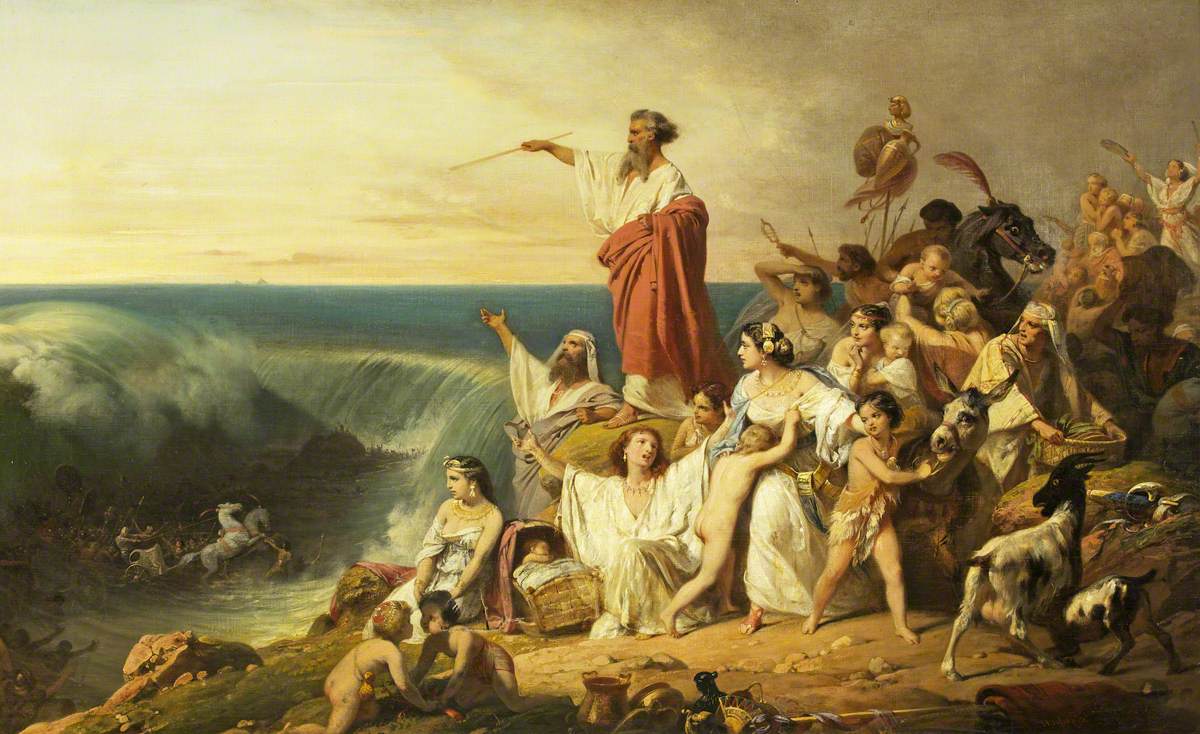
As Pharaoh drew near, the Israelites looked back, and there were the Egyptians advancing on them. In great fear the Israelites cried out to the Lord. They said to Moses, “Was it because there were no graves in Egypt that you have taken us away to die in the wilderness? What have you done to us, bringing us out of Egypt? Is this not the very thing we told you in Egypt, ‘Let us alone so that we can serve the Egyptians’? For it would have been better for us to serve the Egyptians than to die in the wilderness.” But Moses said to the people, “Do not be afraid, stand firm, and see the deliverance that the Lord will accomplish for you today, for the Egyptians whom you see today you shall never see again. The Lord will fight for you, and you have only to keep still.”
Then the Lord said to Moses, “Why do you cry out to me? Tell the Israelites to go forward. But you lift up your staff and stretch out your hand over the sea and divide it, that the Israelites may go into the sea on dry ground. Then I will harden the hearts of the Egyptians so that they will go in after them, and so I will gain glory for myself over Pharaoh and all his army, his chariots, and his chariot drivers. Then the Egyptians shall know that I am the Lord, when I have gained glory for myself over Pharaoh, his chariots, and his chariot drivers.”
The angel of God who was going before the Israelite army moved and went behind them, and the pillar of cloud moved from in front of them and took its place behind them. It came between the army of Egypt and the army of Israel. And so the cloud was there with the darkness, and it lit up the night; one did not come near the other all night.
Then Moses stretched out his hand over the sea. The Lord drove the sea back by a strong east wind all night and turned the sea into dry land, and the waters were divided. The Israelites went into the sea on dry ground, the waters forming a wall for them on their right and on their left. The Egyptians pursued and went into the sea after them, all of Pharaoh’s horses, chariots, and chariot drivers. At the morning watch the Lord, in the pillar of fire and cloud, looked down on the Egyptian army and threw the Egyptian army into a panic. He clogged[a] their chariot wheels so that they turned with difficulty. The Egyptians said, “Let us flee from the Israelites, for the Lord is fighting for them against Egypt” (Exodus 14:10-15:1)
Then the Lord said to Moses, “Stretch out your hand over the sea, so that the water may come back upon the Egyptians, upon their chariots and chariot drivers.” So Moses stretched out his hand over the sea, and at dawn the sea returned to its normal depth. As the Egyptians fled before it, the Lord tossed the Egyptians into the sea. The waters returned and covered the chariots and the chariot drivers, the entire army of Pharaoh that had followed them into the sea; not one of them remained. But the Israelites walked on dry ground through the sea, the waters forming a wall for them on their right and on their left.
Thus the Lord saved Israel that day from the Egyptians, and Israel saw the Egyptians dead on the seashore. Israel saw the great work that the Lord did against the Egyptians. So the people feared the Lord and believed in the Lord and in his servant Moses.
Then Moses and the Israelites sang this song to the Lord:
“I will sing to the Lord, for he has triumphed gloriously;
horse and rider he has thrown into the sea.
Salvation from Bondage
We fancy ourselves citizens in the land of the free and the home of the brave. How then can we enter into the story of the Exodus? Most of us, after all, are more like the Egyptians than the slave nation, Israel. We enjoy power and privilege. We take for granted the services of less privileged people far and near as we go about our business and leisure. While most of us deny that we resort to violence to keep marginalized and vulnerable people in their places, we live our days quietly unbothered by them because of state-sanctioned violence, past and present, that keeps them at bay.
Yet, biblical faith requires identification with the slave nation, Israel. For salvation always means salvation from something, and throughout scripture, that means salvation from bondage. When Jews and Christians celebrate, we celebrate liberation by the powerful God who loves us.
Then we read scripture passages depicting God as angry or even violent: Close examination of those texts reveals God wounded and betrayed by people who, in worshipping other gods, forget that only one God saved them or their ancestors from bondage. Moreover, God gets angry over failures to care for those in bondage or wilderness wanderings now, the widow and orphan, the elderly parents, the poor and the alien fleeing from persecution or systemic poverty. Failure to care implies forgetful ingratitude for God’s care that God bids us extend to others.
But God’s anger is for a day, God’s favor and grace for a lifetime. While we enjoy the freedom and privilege of ancient Egyptians, God extends to us the invitation to receive the salvation of Israel as our own. To really appreciate that grace and respond from our hearts, we must somehow draw on our own experience to empathize with the bondage of others from which God also saves us. In spite of our privileges, life gives us plenty of opportunities.
Salvation and the Assaults of Chaos
For amid life’s beauty, chaos still churns. The Bible begins with God bringing beauty and order out of chaos with a word. Yet, the lives of the Israelites and Egyptians as well as our own lives expose plenty of residual chaos. From the necessity that all animals kill to eat to the inevitability that political leaders sacrifice human lives just to keep a grip on power, chaos bites. From senseless deaths in storm and flood to those on battlegrounds, highways, and lonely suburban bedrooms, chaos assaults. And in souls consumed by resentment, conflicted by guilt, or hijacked by addiction, chaos wreaks havoc.
In scripture, stormy, deep waters represent chaos. If creation begins with a word and a wind from God transforming chaotic waters into the beauty of creation, liberation begins at the shores of the Red Sea with an army closing in. Leading the charge from behind is Pharaoh, the king of Egypt to whom his people and even slaves turn for worldly security. But to Pharaoh, managing and delegating that security is not for the benefit of people who turn to him. Rather, it is a means for power over them, power he hoards because, well, he can.
The Failure of Pharaoh
Through Moses, God gives Pharaoh multiple chances to drop the power game and do his job, to really take care of his people. He needs only let God’s people go. With every chance God gives him, Pharaoh refuses, and his people suffer: Blood in the water supply, frogs in the living room, lice in the hair, flies in the pantry, mad cow disease, boils, hail, locusts in the fields, winter arctic darkness, and worst of all the death of the firstborn. Pharaoh could have chosen to spare himself and his people these miseries. Instead, he chose domination, and his people suffered. He failed as a king every time (Exodus 7:14-12:30).
When God hardened his heart, that does not mean God forced his decision. The hardening of the heart came after Pharaoh decided, so it means that God strengthened his resolve to give 100% to his choice to pursue total power, resulting in colossal failure at doing his job of taking care of his people. The King of Egypt, like so many kings after him, is no protector after all but a dealer in chaos.
In this final plague at the Red Sea, Pharaoh’s initial ambivalence is clear: He chooses to let the slave nation go after the deaths of firstborn sons. Then horrified by relinquishment of power, he changes his mind yet again. God strengthens his resolve because God is the ultimate judo master, using the force of the opponent against him. So Pharaoh marshals his troops, every soldier, every horse and chariot, including himself and his own. He salivates when he sees the slave nation seemingly meander to the shore of one chaos, the Red Sea, where he can pin them in from the rear with his chaos.
Salvation from the Lure of Bondage
But they do not meander there. They obey in spite of themselves. With irony worthy of high comedy – which, in a sense, this story is –
They said to Moses, “Was it because there were no graves in Egypt that you have taken us away to die in the wilderness? What have you done to us, bringing us out of Egypt? Is this not the very thing we told you in Egypt, ‘Let us alone so that we can serve the Egyptians’? For it would have been better for us to serve the Egyptians than to die in the wilderness” (14:11-12).
Here is another chaos: We human beings want freedom desperately and dread it despairingly. We want it because, without it, we cannot live as our true selves and cannot offer our fullest gifts and capacities. But freedom ramps up our anxiety. For we make our choices and sacrifices and gambles with no guarantees short of God’s blessing. Yet, shrouded behind a cloud, God’s thoughts are not our thoughts, God’ s ways not our ways (Isaiah 55:8-9). Kings and others who would control us look very appealing from that liminal field because at least we can understand a narcissist. We have had a lot of practice at that.
On God’s behalf, Moses meets this chaos with compassion and meekness, meaning strength and tenderness. He knows they are afraid. He respects that. Moses likely feels afraid himself. “But Moses said to the people, ‘Do not be afraid, stand firm, and see the deliverance that the Lord will accomplish for you today, for the Egyptians whom you see today you shall never see again. The Lord will fight for you, and you have only to keep still’” (vv. 13-14). That is the highest expression of freedom: inner stillness in the face of chaos, choosing to trust God, the one true King who is Love.
Two Kinds of Fear
In scripture, it is often called, “the fear of the Lord,” by the way. Another word for it is “faith.” Notice that Pharaoh has now blended in among his troops, unnamed. Along with them, he experiences another kind of fear: terror in the face of God, panic in the face of chaos, or more precisely, in the face of the one true God who demonstrated control of nature nine times before, which Pharaoh dismissed over and over again.
The Creator, the only God who can bring order out of chaos, made us for freedom and so parted the chaotic waters and made a way to salvation. Before crossing, the Israelites found the Egyptians and the wilderness terrifying, just as the Egyptians were terrified before the face of God as they tried to jimmy their stuck chariots from the muck as chaotic waters converged. In their dying words, they spoke the truth that Pharaoh could not bear to admit: God fights for these slaves, sees them to freedom with irresistible force.
Meanwhile, the Israelites who saw the entire Egyptian military dead on the shore moved not only from peril to safety but from fear of Pharaoh to fear of God, from a life resigned to pleasing a despot to a life of honoring the God who ruthlessly frees them to love, to live the vocation for which God made Adam from the mud. Chaos still threatens in the wilderness ahead, the promised land they will settle, and their own proud choices and hardening hearts. They will fail like Pharaoh over and over themselves, but God will remain faithful.
Such is our God. And such is our story.
Related Posts
Truth in the Wind: A Sermon on John 16:12-15
The Order for which We Long: A Sermon on John 1:1-18
Overwhelming and Unbelief: A Sermon on John 6:1-21
Blessed are the meek, for they will inherit the earth (Matthew 5:5).
0 Comments