
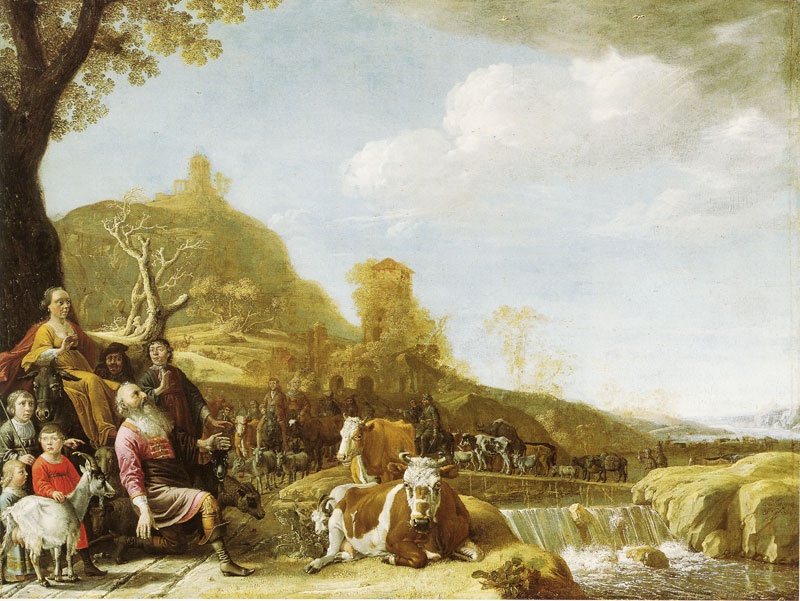
Now the Lord said to Abram, “Go from your country and your kindred and your father’s house to the land that I will show you. I will make of you a great nation, and I will bless you, and make your name great, so that you will be a blessing. I will bless those who bless you, and the one who curses you I will curse; and in you all the families of the earth shall be blessed.”
So Abram went, as the Lord had told him; and Lot went with him. Abram was seventy-five years old when he departed from Haran. Abram took his wife Sarai and his brother’s son Lot, and all the possessions that they had gathered, and the persons whom they had acquired in Haran; and they set forth to go to the land of Canaan. When they had come to the land of Canaan,
Abram passed through the land to the place at Shechem, to the oak of Moreh. At that time the Canaanites were in the land. Then the Lord appeared to Abram, and said, “To your offspring I will give this land.” So he built there an altar to the Lord, who had appeared to him. From there he moved on to the hill country on the east of Bethel, and pitched his tent, with Bethel on the west and Ai on the east; and there he built an altar to the Lord and invoked the name of the Lord. And Abram journeyed on by stages toward the Negeb (Genesis 12:1-9).
The Sweetness and Light of Genesis 1-2….
Genesis begins with a song. God confronts chaos with lyrics, not violence. Out of the formless void, God fashions all things with words and calls them good. Humans made in God’s image crown it, made to love God and one another freely.
Chapter two shifts to narrative and locates Adam and Eve in a garden. There God draws a line against misusing freedom to try to become more than they are. Thus, God tries to head off the problem of anxiety. As for the problem of loneliness, God makes them partners in the glad business of enjoying and cultivating creation together.
….then the Great Debacle of Genesis 3-11
From this idyllic scene, the great debacle proceeds in chapters three through eleven. Chaos makes a comeback. The freedom necessary for love sets the stage for disobedience. So against instructions, they eat the fruit that gives knowledge of good and evil. Anxiety and defensiveness naturally ensue. Now they know they are naked. Loneliness arises as the humans blame each other. God has mercy, gives them the life they asked for with all its anxiety and loneliness. And God continues to love them.
More tragic chapters ensue in the great debacle. Adam and Eve’s oldest son, Cain, invites his brother Abel to worship, the Bible’s first recorded call to worship. Worship means offering sacrifices, and God shows partiality to Abel’s offering. So ironically, Cain descends from saint to sinner and kills Abel in jealousy. God has mercy on the murderer too, but gives him what he wanted, sending him down a lonely road.
Humanity falls into such depravity that God regrets creating us and sends a great flood. God conserves only Noah and the males and females of as many species as Noah could jam onto a large boat constructed far from shore. Then God repents. More than that, God offers the first covenant, signified by a rainbow, promising never to wipe us all out with a flood again. Violence offers no final solution.
The debacle continues as the humans remain hell-bent on making themselves equal to God. With newfound technological savvy, they start construction of a tower in Babel. They hope to reach heaven and bypass the need for God’s grace. So God diversifies their languages, which separates them from each other and subverts their proud project. This leaves them with the very loneliness God tried to prevent in the first place. What a debacle, indeed.
The Turning Point at Genesis 12:1-9
But Genesis 12 marks a turning point not from debacle back to paradise, but into history as we live it today. The debacle continues, but so does grace. God’s creative love still interweaves darkness and light. This fresh divine project climaxes in the death and resurrection of Christ. It continues in the Holy Spirit’s redemption of all people and creation itself. But the witness of mere mortals plays a key role too.
For God spoke creative words again, not to chaos commanding it to take on forms, not to holy hosts commanding them to overwhelm us with displays of power and beauty, but to an old man, a misfit with nowhere to go and no future. In those ancient days, long before modern overpopulation, mutual funds, public military and police forces, and grocery stores, feeding, protecting, and sustaining the family depended on a workforce of sons and daughters. And this old man’s wife was barren. Theirs seemed an impoverished, almost wasted life compared to their neighbors.
We do not know why God reached out to that particular couple, Abram and Sarai. Perhaps their faithfulness to each other and to God despite the infertility prepared them. Thus schooled in hoping for things unseen, they learned the faithfulness necessary to respond to a wild promise. So when God called, they rose up with achy knees, packed for a journey, and prepared for a pregnancy that would blow the OBGYN’s mind. Whatever the reason, God issued precisely that promise to Abram and Sarai.
“You Will Be a Blessing”
In the beginning, God created all things with words, blessed them and called them good. But amid resurgent chaos and mistrust of God and each other, God offered a new blessing in humble, human form. God said, “I will make of you a great nation, and I will bless you, and make your name great, so that you will be a blessing. I will bless those who bless you, and the one who curses you I will curse; and in you all the families of the earth shall be blessed” (12:2-3, emphases mine).
God said that to Abram, blessing him and Sarai. But it was not only for them. It was for the whole world, all of creation. Through them and their offspring, through the journey itself, God blessed a world formed in love and for love but riddled with residual chaos and sin. God took Abram and Sarai from no blessing to abundance, from no hope to the promise of a family, from insignificance to having names, Abraham, meaning, “father of a multitude” (17:5-8) and Sarah, meaning, “mother of nations” (17:15-16). They moved from debacle to hope. They became parents of a priestly nation founded in love. And this beloved nation had a mission, to bear witness to the Creator’s love to all nations and people.
Abraham and Sarah, You and Me
You and I are not Abraham and Sarah. We neither existed in that historical moment nor heard such words or received that command amid barrenness. We take for granted that we will make our last lifestyle decisions in our twilight years. Some may travel or spend time with grandchildren. Others may take on a serious hobby with work out of the way. Many will oil and clean rusting body parts. We anticipate no epic journeys ahead, not much more to say for ourselves than we can say now.
Yet, you and I are Abraham and Sarah. God blesses you and makes you a blessing through whom God blesses the world. The journey and fruit of your life blesses the world.
Yet, does the common debacle dominate your outlook? Do you object that your bank account or resume do not square with the promise of blessings? Neither did Abraham and Sarah’s. Do you object that too much barrenness, grief, or estrangement plague your family, church, or other social relations? So it was with Abraham and Sarah. Does your life lack significance, already overlooked and forgotten before your dying day? So it seemed with Abraham and Sarah.
Moreover, does God’s commission to Abraham and Sarah look impossible for you? Just so for them. Yet, they became blessings not by setting up a grand enterprise, conquering an enemy army, or charming the world with celebrity. They became blessings by trusting God’s promises and organizing their way of life not around the best bets in the market but around the words of God, however outlandish.
Living the Faith and Witness of Abraham and Sarah
You are Abraham or Sarah if, in faith, you ever take risks, venture out without a map, forsake securities centered on yourself or something less than God. You are Abraham and Sarah if you ever give of yourself and your talents and resources with no return in sight, trusting God to bring them to fruition whether you ever taste the fruit or not. Finally, you are Abraham and Sarah if the prospect of new life springing from yours makes you laugh as it did the two of them before they named their son, Isaac, meaning, “laughter.”
The history of Israel records a politically failing nation that nevertheless still blesses us with a book full of all-too-human witnesses to the one, true God. In the history of that nation and the world, God sent a Son, Jesus, a working class guy who trusted God through dereliction and death, saving the world in the process. Paul, a scholar of the Abrahamic tradition, encountered the risen Christ and spread the good news that we Gentiles too belong in Abraham’s family through faith like his. He likened us to clay vessels carrying the treasure, God’s blessing through Christ, to all the world (2 Cor 4:7), vessels like Abraham and Sarah, you and me.
Claiming the Blessings, Being a Blessing
So bless the world. Blessings bestow power for life and wholeness. Christ bestowed that power upon you explicitly in his Beatitudes.
He blessed the humble, grateful, bereft ones who seek God without promoting themselves. They yearn to please God and share mercy like God’s with others. Their single minded devotion to God leads them to build bridges, love their enemies, and face whatever seemingly hopeless and painful passages may come on the way to the promised kingdom of heaven.
Sounds like Abraham and Sarah. But it also sounds like you when you take an honest look at yourself in prayer and let the Spirit set your sights beyond the debacle. God calls you to be such a blessing, salt and light of the world. Then you bear witness to that promise and cannot fail as long as you consent to God’s loving presence and action in your life (see Mt 5:3-16).
Whatever weighs upon your soul as a church, as a citizen of this nation, as a family member, or as an individual looking for a way out of loneliness and anxiety, trust God. Yes, chaos still churns. Purpose seems to slip away in both civic and private life. The order we had breaks and scatters, and cynicism washes over truth and integrity. But despite the debacle, God’s creative work continues, and our vocation as God’s people remains like that of Abraham and Sarah, to trust the promises of God and move forward on a way discerned by love and filled with hope. For God blesses us, and from God all blessings come. There will be Laughter.
Related Posts
Witness Defined: See the Beatitudes
Clay Jars and Peculiar Treasures: Saints in Buechner’s Writings

0 Comments