
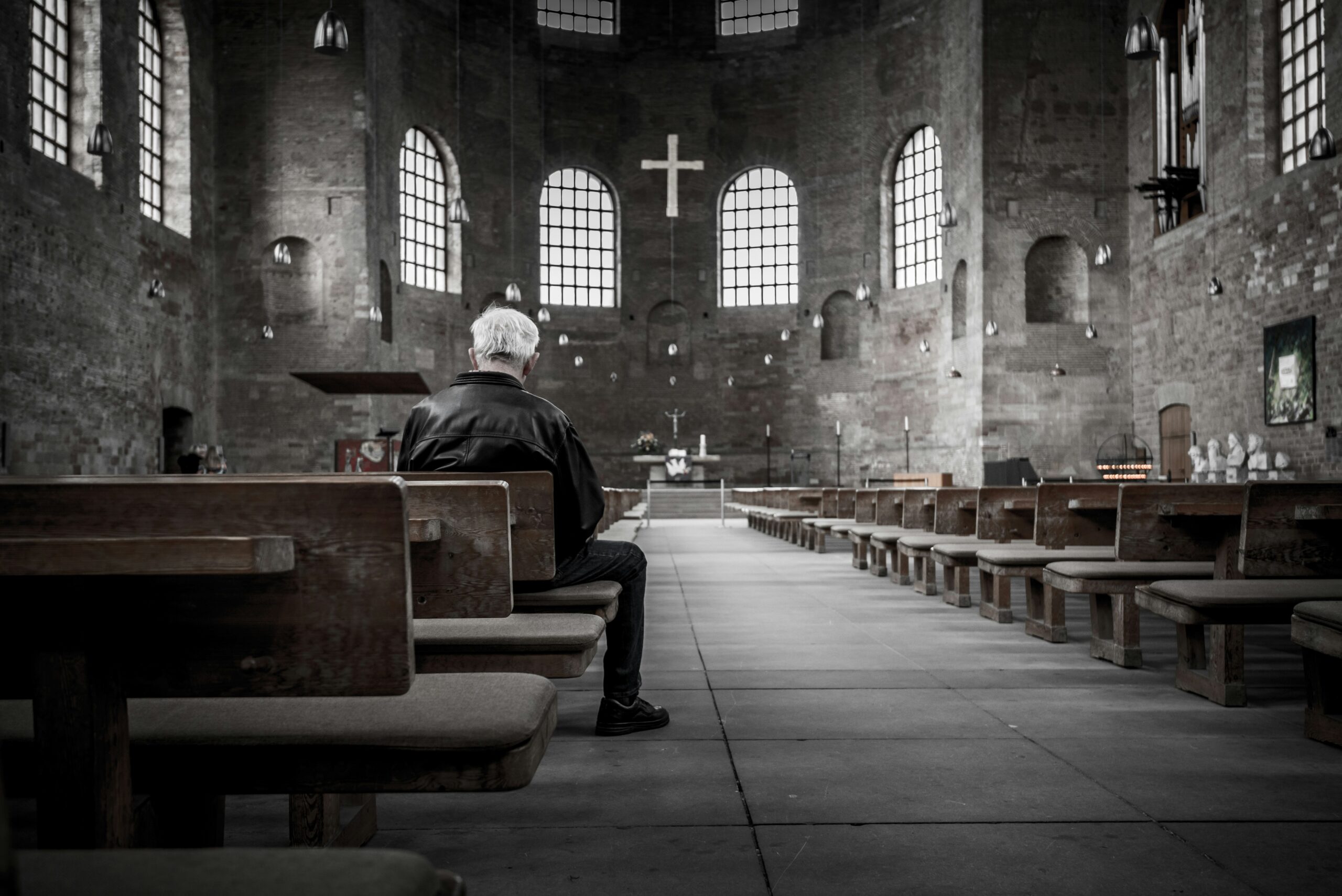
The Call
Around age 11, I heard the call. No burning bush spoke my name, and no seraphim in the sanctuary sang, “Holy, holy, holy.” Nor did a face appear with a booming voice surrounded by smoke like the Wizard of Oz. The call came through scattered experiences pulled together in a mosaic: a prick of conscience here, a reading of scripture there, a sense of stability among adults in church, the eyes of a frightened, black child, a sense of Christ’s presence in conversations with wise and wounded souls, an inviting sense that Jesus had better things for me to do than just be a good boy. God addressed me amid the serious games of growing up in the humid tobacco country of southeastern North Carolina.
Sermons at the Presbyterian church started to matter. In time, the pastor’s extensions of interest and care mattered too. Also, my mother worked as the office manager at the Episcopal Church a few doors down. Her stories of daily life with Father Teasley and the faithful there formed an impression of the clergy role. He counseled many throughout the week who unloaded their grief and loneliness into Father Teasley’s listening ear. Of course, he prepared sermons every week, so I envisioned a life of care, study, and preaching. With my knacks for biblical interpretation, empathic listening, and turns of phrase, that life looked ideal.
Preparation for a pastoral career started in high school when I volunteered as a telephone counselor at the mental health center, which I continued through college. I worked a couple of summers as a youth minister at a community church led by a liberal Southern Baptist pastor.
Things Shifted
Things shifted. Somehow I felt more of a sense of God while telephone counseling than working at the church. On the positive pole of that problem, a spirituality deepened with the counseling work as I sensed Christ’s presence in serving “the least of these.” Christ shone through honest confessions of vulnerable souls.
On the negative pole, I felt a sense of inner conflict about the laity at the church. I liked and cared for them and they for me. But I came face-to-face with an old conundrum that even bothered me at the church back home: These very smart people – the adults, not so much the kids – could talk over my head about investments, building the best house, and making smart career moves. Yet, as far as I could tell, few gave much thought to the life of faith. The pastor preached well, and I preached occasionally. But I could not see the carefully and colorfully chosen words make a dent on their lifestyles, their hopes and dreams.
The worry that what we call church might not be church at all plagued me. Does a pastor just run a community center to give families with children a wholesome place to gather with periodic bows to a deity whom they do not take seriously? I could not get to no, but I wanted to. I deferred admission to divinity school to think about it for a year. One year became forty six.
The Call Revised
So here I stand before you, too late for seminary. We discern God’s leading most clearly in retrospect. Now I recall that God said in so many words and ways, “Marshall, I call you to take up the challenge you want church people to take. Live the life of faith without making it your job. Face the temptations and trials that draw even the most sincere layperson into a compromised life. See how it feels. You will make mistakes. But in spite of it all, I will fulfill the calling I issued to you when you were a child. For you are still my child, and it gives us both joy for you to give back your gifts.”
At 16, I preached a Youth Sunday sermon simply entitled, “Ministry.” I said that we church people ought to do more of that and not leave it all to the pastor. So my words came back to challenge me.
Ministry is service for the betterment of another party, and Christian ministry provides service in the name of Christ. That entails more than attaching his title to it. It requires obedience. Many borrow the name of Christ for misguided purposes, but God blesses those who prayerfully seek obedience to Christ.
Americans cherish freedom as liberty from the constraints of others, listening only to ourselves and choosing accordingly. We distrust authority. So we do not like the term, “obedience.” But baptized Christians cherish a more substantive freedom. The term, “obedience,” derives from the Latin, oboedire, meaning, “to listen.” We listen to our desires like everyone else, but only after we consent to the Holy Spirit shaping them. Above all, we desire to align our will with God’s. Ultimately, we listen to our desires to discern God’s desires, which may or may not square with what we wanted at first. The Spirit shapes our desires in the form of Christ’s love. So we, like Christ, detach from self to find ourselves in a surrendered life, a life of worship and service.
Respect for Clergy
For this obedient life, God gives us a lot of resources: scripture, prayer, theological tradition, examples of saints, and, of course, each other, the worshipping community. Ordained clergy lead that community. After slip-sliding away from my intention to join them, I see their crucial role more clearly from a distance.
We need clergy to administer the sacraments, lead worship, and encourage use of our gifts in service both within and outside of the church. Yet, the clergy need us too, not only to attend, pony up our pledge, and bring a friend occasionally to keep the numbers rising. Clergy need us as partners in a witnessing community. If only clergy witness to the love of Christ, laypersons merely cheerlead specialists and support them with donations. But God calls the Body of Christ, all of us, to bring to light Christ’s presence and action in the world. So lay ministry without clergy support is blind, while ordained ministry without the service of the laity is empty.
When I felt sure I was on the road to seminary and ordination, I talked to my grandfather, a Presbyterian pastor with missionary service in Japan, parish ministry, and VA Chaplaincy on his resume. When I told him that I intended to follow the route he did, he said, “You know, son, it is the loneliest profession in the world.” Loneliness and I already shared a long companionship, so his comment did not deter me on the spot. Yet, I got his point that it is a hard life. I have always respected ordained clergy for that.
Proclamation Without a Pulpit
Eventually I realized how difficult and even lonely it can be to take one’s ministry seriously as a layperson. Everyone, including the clergy, assumed that I settled for an easier way. I discerned gifts for good deeds and gave them, specifically, a listening ear and some studied guidance. Good work. That should suffice. But it does not.
For Christ called us to couple our acts of service with proclamation of the Gospel. On the face of it, that seems to mean either get a pulpit or go to the Hardee’s parking lot with a handful of tracts and offer people fire insurance if they will just repeat after me. But no, the ministry of proclamation means living the Gospel in such a way that we follow the legendary counsel of St. Francis: “Preach the good news always. Use words if necessary.” All of us, laity and clergy, face the daunting challenge to cultivate the mind of Christ as the motivating force behind our service. That requires solitary work of prayer with study and self-examination before God. Ironically, we learn, among other things, that we cannot do it alone.
Sinner and Servant
I could have pursued my long career as a psychologist for good enough earnings and a sense of contributing to the general welfare. You can too whatever your occupation, regardless of levels of earnings, status, and power. Nothing wrong with that. But Christ who said, “Take up your cross and follow me,” and, “The first will be last and the last, first,” blessed not the high-flyers but the humble, grateful, broken hearts who long for a righteousness they do not have. He showed us in the Sermon on the Mount that we need grace as much as the murderer or rapist.
As pointedly as he questioned the remaining eleven disciples, he asks us why we do not stay awake with him in the hour of his torment. He forgives us, for we do not know what we are doing. Then he forgives again even as he invites us to carry on the mission after his resurrection and ascension.
This Christ bids us serve with battered and purified hearts, promising that the pure in heart will see God, We will see him in glimpses amid all the human mess, if only in a glass dimly. We will clearly see him in eternal life. Such vision unfolds amid prayer and service, both of which come to much more than earning a salary and a respected place in the community. They amount to intimacy with Christ. And this intimacy delivers life’s greatest challenges and joys.
Many receive baptism and then move on, foregoing both the challenge and joy. For such intimacy requires being fully awake, fully alive, and that takes discipline. In an already demanding life, why not just meet expectations?
As someone who embraces the challenge to take my ministry seriously without a collar or title, I do not experience myself as any more precious in God’s sight than those who do not embrace that challenge. But I also see more clearly with every passing year that God really is like the father of the prodigal making a mad dash to embrace the son who forsook him. So whether we stray or delay this intimate relationship with Christ for moments or years, every return is a party. And every assignment we accept leads ultimately to the warm light of divine love.
Blessed are those who hunger and thirst for righteousness, for they will be filled (Matthew 5:6).
Related Posts
Vocation: Your Deep Gladness Meets the World’s Deep Hunger
Crisis Telephone Contemplation
Here We Are: Remembering Betty Marshall Jenkins
For My Father, C. Rees Jenkins, Jr., 1926-2016
Photo by Stefan Kunze on Unsplash. Public Domain.
Marshall, thank you for sharing. So well written. I had no idea about your spiritual journey. You have always been so incredibly intelligent and sensitive. I appreciate your honesty and the depth of your feelings. Thank you.
Thank you so much, Shelley! I remember your generous spirit from our childhood, and your comment suggests you have not changed that! I have heard good things about your work in higher education, and I believe we have something in common there. I really appreciate your reading my post and your kind words.
Thank you, I have much to think about. J.
Glad to help with that.