
Therefore wait for me, says the Lord, for the day when I arise as a witness. For my decision is to gather nations, to assemble kingdoms, to pour out upon them my indignation, all the heat of my anger; for in the fire of my passion all the earth shall be consumed. At that time I will change the speech of the peoples to a pure speech, that all of them may call on the name of the Lord and serve him with one accord. From beyond the rivers of Ethiopia my suppliants, my scattered ones, shall bring my offering. On that day you shall not be put to shame because of all the deeds by which you have rebelled against me; for then I will remove from your midst your proudly exultant ones, and you shall no longer be haughty in my holy mountain.
For I will leave in the midst of you a people humble and lowly. They shall seek refuge in the name of the Lord— the remnant of Israel; they shall do no wrong and utter no lies, nor shall a deceitful tongue be found in their mouths. Then they will pasture and lie down, and no one shall make them afraid.
Sing aloud, O daughter Zion; shout, O Israel! Rejoice and exult with all your heart, O daughter Jerusalem! The Lord has taken away the judgments against you, he has turned away your enemies. The king of Israel, the Lord, is in your midst; you shall fear disaster no more. On that day it shall be said to Jerusalem: Do not fear, O Zion; do not let your hands grow weak. The Lord, your God, is in your midst, a warrior who gives victory; he will rejoice over you with gladness, he will renew you in his love; he will exult over you with loud singing as on a day of festival.
I will remove disaster from you, so that you will not bear reproach for it. I will deal with all your oppressors at that time. And I will save the lame and gather the outcast, and I will change their shame into praise and renown in all the earth. At that time I will bring you home, at the time when I gather you; for I will make you renowned and praised among all the peoples of the earth, when I restore your fortunes before your eyes, says the Lord (Zephaniah 3:8-20).
Zephaniah’s Vision of Easter Hope
We read Zephaniah 3:12-20 for Easter because it expresses succinctly and lyrically the ancient hope Christians recognize in the resurrection of Christ. It is a hope for shalom, the peace of God lived in the community of God’s purified people. That peace includes relief from violence and disruption. The “warrior” God, who “turns away….enemies,” removes all “fear….of disaster” and “reproach” for sins, will protect them.
Moreover, this peace goes far beyond absence of strife. It unleashes presence of joy and fullness of life. This warrior God loves the community, “rejoicing over” them like a groom with his bride “on a day of festival.” Like that bride, they will live in right relationship with God, “doing no wrong….uttering no lies….” with a clear conscience and full trust. God will “save the lame and gather the outcast,” fulfilling the justice that God most passionately desires and that human sin heretofore confounded. “I will bring you home,” God promises, and all the world will honor God’s people when their fortune is restored.
The resurrected Christ bears witness to this promise realized. We cannot dismiss the promise as a fantasy without dismissing the risen Lord as a chimera. Easter people abide in this hope.
Background Darkness: The Anger of God
Yet, we cannot see light until we know darkness. Zephaniah acquaints us with the darkness from which this hope emerges in no uncertain terms. If Zephaniah’s brief, three chapter book ends with a vision of shalom, it begins with the starkest cry of God’s rage: “I will utterly sweep away everything from the face of the earth, says the LORD,” (1:2) and the next two and a half chapters elaborate on the ruthless massacre on the creation.
But thank goodness for Noah’s rainbow, the covenant that came before that God would not address evil with complete destruction. The threat to utterly “sweep away everything” is hyperbole. The embellishment comes clear as Zephaniah conveys the promise of hope for the humble.
Nevertheless, Zephaniah may overstate the damage, but the reality remains stark. God is angry, and there will be consequences. God wants justice not only for God’s beloved meek but for God and all the world. With Abraham, God entered into a covenant to build up and make a home for God’s people, Israel. Noah’s rainbow and Israel’s mission as a light to the nations means that God extends that promise of shalom to all. With the exodus, God liberated this people to be a living parable of God’s peaceful kingdom from which the world can learn.
Zephaniah on the Day of the LORD
Yet, after all that, the proud say, “The LORD will not do good, nor will he do harm” (1:12b). In other words, like many in our supposedly Christian nation today, they believe in God but do as they please. Like modern deists, they see God as having finished the work of setting things up for their practical enterprises, mainly for their own purposes, never mind God’s mission for them. This shows up most obviously in our economic common sense in which we trust the self-interested pursuit of profit to suffice for justice and peace. Apparently, similar thinking operated among the Judeans as God’s anger targets “the Fish Gate….the Second Quarter….(and) the Mortar” (see 1:9-11), their equivalent of Wall Street, the New York Stock Exchange, and the Federal Reserve.
Yet unlike Deists, the Israelites expect God to take action….later. They expect, “the Day of the LORD,” a day when God will defeat hostile enemies and make the rest turn from hostile threats to fellow worshippers of the LORD. Yet Zephaniah, like Amos, shocks them with the warning that the Day of the LORD will bring anguish and loss for the proud who dismiss God as irrelevant to their daily affairs and schemes.
Interpreting the anger of God in the Old Testament requires carefully critical reading and spiritual discernment. As noted already, God’s rage often issues in hyperbolic terms for effect. Moreover, it often emerges from normal political discourse of antiquity. The Bible is a library of every kind of genre: the lyrical poetry like Psalms, the narratives like Genesis, the laws like Leviticus, the history of Kings, the criticism of the prophets, and the apocalyptic visions of Daniel. The Old Testament is the national literature of Israel.
In the nations of antiquity, such national literature portrayed the deity as a super warrior, a weapon of mass destruction who wipes out every man, woman, child, and animal of the enemy. All nations told those kinds of tales to reassure the people and prop up their divine warriors. Inconsistencies in the texts and lack of archaeological evidence render them historically doubtful. In a word, the Bible includes propaganda too.
God’s Anger Is About Love, Not Intimidation
Yet, God speaks a word of truth to us even through the propaganda and hyperbole. God gets angry. What does that imply? Before you relegate the angry God to the Old Testament and rest in the sweet, kind God of the New, recheck your gospels and note that Jesus warns of God’s anger there too.
However, the use of such passages to scare and intimidate people into a faux Christianity of fear does more damage than the passages themselves. True Christianity – and true Judaism, for that matter – is motivated by gratitude for God’s love, not terror. God gets angry out of love, not out of a sadistic need to dominate and control. Moreover, anger never gets the last word with God: Mercy, hope, and the promise of justice and peace always does, as Zephaniah illustrates.
Old Testament scholar, Terence Fretheim, understands God’s anger as an outgrowth “of a breakdown in a personal relationship with its associated effects – all the anger, pain, and suffering which would commonly accompany such a breakdown….The analogy of a marriage breaking up is one that could be profitably used in this connection.” You have chosen your beloved, devoted yourself to your beloved’s flourishing with much love and care, patiently borne one betrayal and inconsideration after another until it all adds up. You get angry because you love. So does God.
Often those who employ the images of an angry God to scare people into submission (which likely makes God very angry) latch on to the legal metaphor. Indeed, prophets like Isaiah use the analogy of the courtroom, the judge, and the guilty verdict. But that is one metaphor, and no metaphor covers the whole reality to which it refers, least of all the reality of God.
Relationship and Purification
The metaphor of the wounded and betrayed spouse is at least equally helpful, likely more helpful and prevalent in the Old Testament. God elects a special beloved people who will know God most intimately. God has compassion on them and frees them from slavery. They receive guidance through the Ten commandments and derivative laws to flourish in their freedom. Yet, God forgives them over and over for their complaining and infidelity. The whole of scripture is much more an unfolding love story than a courtroom drama.
Purification is another closely related metaphor here, and it points back to loving relationship. In antiquity, people understood deities as requiring purity for a person to come into the god’s presence for worship, atonement, and blessing. Ancient Israel shared that assumption; hence, they had purity laws about food, illness, blood, even associations with outsiders to assure God’s loving engagement with them.
Zephaniah’s images of fire and sweeping the proud away entail purification of the people. Chapter three verse eight reiterates the invasion by fire, followed immediately by verse nine: “At that time I will change the speech of the peoples to a pure speech, that all of them may call on the name of the Lord and serve him with one accord.” The purified people are now free for authentic relationship with God; only their purity is now more an inner matter, one of character and heart, not external touch and taste. In this, Zephaniah prefigures Jesus’s beatitude, “Blessed are the pure in heart, for they will see God” (Matthew 5:8).
The Joy of the Humble, the Blessing of the Meek
These points do not answer all the questions of theodicy – justifying the ways of God with humans – but it helps put them in perspective for realistic faith. The anger of God springs from God’s love, not a passion to hurt and dominate. Zephaniah focuses on God’s anger over pride because nothing cuts the oxygen off of a loving relationship like pride. Pride boomerangs love back to the self and builds the delusion of self-sufficiency, of not needing to be faithful to God or anyone else. Human history records the ultimate lethality of that boomerang’s return time after time.
So Zephaniah offers the joy of the survivors, the humble, the meek. The word, “humble,” derives from the Latin, humus, meaning, “earth,” and its derivative, humiis, meaning, “lowly,” or, “on the ground.” This does not imply a self-deprecating, wishy-washy, passive doormat. Rather, the humble are the grounded ones, the ones who see reality most clearly because they keep their egos out of the way. They do that by loving God not only with their beliefs but with their lives. The closely related term, “meek,” entails strength used for gentleness. They could throw boomerangs, but instead, they build bridges, homes, and vineyards. According to Zephaniah, these grounded, strong, gentle lovers of God will survive God’s wrath. And as Jesus promised in another beatitude, “Blessed are the meek, for they will inherit the earth” (Matthew 5:5).
This blessed remnant remains after all the boomerangs lie still and scattered over the earth. They fulfill the purpose for which God makes humanity and calls a people to live in such peace that the world knows the glory of the loving God and becomes meek itself. We believe that Christ extends the identity of God’s purified and meek people to include us and that his death and resurrection liberate us from ultimate control by sin, in this case, the sin of pride. Christ gives us the ticket to the party, but to really dance there, we do as another Old Testament prophet, Micah, conveyed: “Do justice, love kindness, and walk humbly with the LORD” (6:8). That is not a stern order but a smiling invitation.
Related Posts
Compassion Spills From God’s Broken Heart
An Apology for Caspar Milquetoast
What We Want Is Glory: A Reflection on Isaiah 4:2-6
Blessed are the meek, for they will inherit the earth….Blessed are the pure in heart, for they will see God (Matthew 5:8).
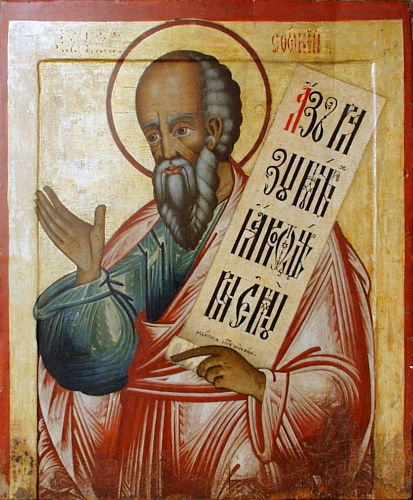
Image: “Prophet Zephaniah,” 18th Century Russian Icon, Wikimedia Commons, Public Domain.

0 Comments