
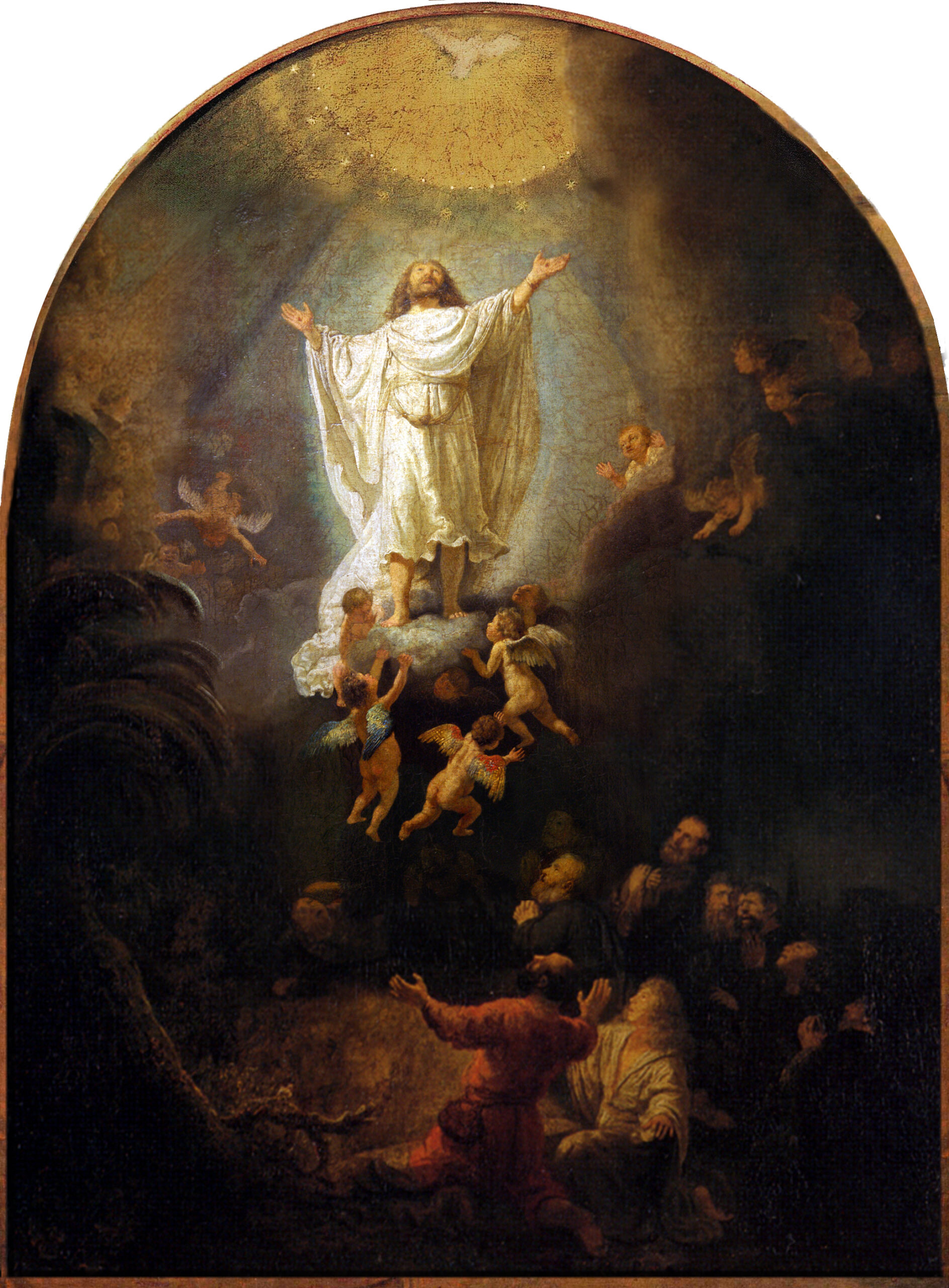
So when they had come together, they asked him, “Lord, is this the time when you will restore the kingdom to Israel?” He replied, “It is not for you to know the times or periods that the Father has set by his own authority. But you will receive power when the Holy Spirit has come upon you; and you will be my witnesses in Jerusalem, in all Judea and Samaria, and to the ends of the earth.”
When he had said this, as they were watching, he was lifted up, and a cloud took him out of their sight. While he was going and they were gazing up toward heaven, suddenly two men in white robes stood by them. They said, “Men of Galilee, why do you stand looking up toward heaven? This Jesus, who has been taken up from you into heaven, will come in the same way as you saw him go into heaven.”
Then they returned to Jerusalem from the mount called Olivet, which is near Jerusalem, a sabbath day’s journey away. When they had entered the city, they went to the room upstairs where they were staying, Peter, and John, and James, and Andrew, Philip and Thomas, Bartholomew and Matthew, James son of Alphaeus, and Simon the Zealot, and Judas son of James. All these were constantly devoting themselves to prayer, together with certain women, including Mary the mother of Jesus, as well as his brothers (Acts 1:6-14)..
The Ascension: Not an Ending, but a Beginning
Today’s text from Acts pushes 2000 years old. You know that. What a boring way to start a sermon. Yet, Jesus told them the future remained as uncertain and unbounded as ever. Furthermore, two odd characters in white told them to brace themselves for another big event. All this rocked their world. It shattered their assumption that the story was ending then and there. Surely now the Messiah will deliver Israel to peaceful sovereignty. Instead, his ascension kicked off a whole new series of chapters in which we participate today. His promised presence often seems like absence. The story remains unfinished.
Yes, this was unsettling, confusing, and far from boring. It should be for any of us 2000 years later who take God’s promises seriously. For they thought Christ accomplished everything necessary to step up to the throne and fulfill Israel’s ancient hope, to satisfy the hunger and thirst of generations before them. The Messiah came. Here he stood. His life, even his death, fulfilled pages of prophecy. Moreover, beyond the wildest hopes of years gone by, he even conquered death. Here he stood with scars on his hands and feet and grilled fish settling in his belly.
What remained for God to do before calling history a wrap and letting Israel take its rightful place as the priestly nation to whom all nations turn for truth, peace, and endless tranquility? “Lord, is this the time when you will restore the kingdom to Israel?” they asked. Why not finish the job then and there? Why start another raucous odyssey of religious divisions, persecutions, proliferating questions, hypocrisies, idolatries, pointless wars, and sin after sin both against and by Christians?
Unlikely Witnesses
More specifically, why gather a congregation in Rome, Georgia in 2026 to worship an invisible, silent God revealed in a Son whose face only a few saints and quacks claim to have seen since his ascension two millennia ago? Furthermore, I, who see your faces, behold a sea of good-looking people. But God who sees the heart beholds a mess of mixed motives.
In varying degrees, those motives are on and off point. One person attends church to mollify the wife and kids, another to keep an addiction at bay. Still another attends for wholesome fellowship with old friends and making good business connections. Meanwhile, the person sitting another pew back silently weeps in gratitude for unmerited graces. An aesthete glories in the pipe organ music and stained glass windows. A few seats closer to the door, an intellectual carries on an inner dialogue about justification by faith. Some secretly harbor doubts that God amounts to anything more than an imaginary friend. Others find the truth of it all getting larger and larger, filling their world. Reverie upon reverie punctuate all these musings.
Furthermore, God who sees our hearts hears the cacophonous mix of each individual’s motives. God sees our hurry to get on to afternoon plans, our ruminations over the week’s problems, our guilt over singing hymns when we have work to do. Thus, we flawed, muddling mortals wait for God.
Meanwhile, 2000 years ago, Jesus gave the first disciples a paradoxical message: God withholds the itinerary for salvation history, so they have to learn how to wait in uncertainty. Yet, God will shortly send the Holy Spirit to empower them to do their critical part, their job. Whether they must wait a few minutes or a few millennia, he does not say. Despite their mixed motives, fears, and distractions like ours, he commissioned them to serve as witnesses in Jerusalem, yes, and much further out from there, beyond the boundaries of the Judaism they know to the ends of the earth.
The Meaning of “Witness”
What does it mean to be a witness? That question remains as critical now in Rome, Georgia as 2000 years ago on the Mount of Olives. We know that in court, a witness swears an oath on the Bible and attests to empirical observations, usually with strict instructions from an attorney not to offer opinions or spin yarns. Just the facts, ma’am.
The definition expands when we speak of the witness of an artist, say, a poet, whose corpus expresses an accumulated truth that facts cannot contain. The literary critic says that a particular poet bears witness to the grit of colonized people, to signs of transcendence in everyday life, or to care in an indifferent society, to name a few possibilities. Witness here means expressing truth as deeply held conviction, usually derived from the artist’s own suffering love.
To such witness as that, Jesus calls us. Only it begins with Jesus’s suffering love for us with all our mixed motives, transgressions, and downright cussedness. Then it rolls over into our suffering love for him and for all his beloved, especially for the unlovely. We can tell it in the story of Jesus, as Peter did in the verses immediately following our text in Acts. And we can express it in poetry if we want. But more to the point, we express it with our lives, how we conduct business, respond to interruptions, occupy our minds during chores, and bear the suffering of others.
Witnesses and Martyrs
Moreover, to true witnesses, “our lives” are not really ours. Rather, Christ lives in and through us. We bear witness with surrendered lives, with decisions and convictions rooted not in our recalcitrant egos but in our consent to the Holy Spirit, that invisible and strangely personal force in which “we live and move and have our being” (Acts 17:28). To paraphrase the witness attributed to St. Francis, we “preach always and use words if necessary.” And sometimes it is necessary. Sometimes we need the courage of faith to speak our truth rather than simply play along with idiotic prejudices.
The early church revered martyrs. “Martyr” derives from the ancient Greek term, martus, meaning “witness.” Our epistle reading comes from the First Letter of Peter (4:12-14, 5:6-11), a letter of exhortation for martyrs. The primary reason for martyrdom came down to not saying what the powers wanted, specifically, not calling the emperor a god. So expect to suffer even for doing right, and count it sharing in Christ’s sufferings. Then Christ counts it as bearing witness. Witness does not always win friends and keep you safe. But it draws you nearer to God, and God will use your witness to make witnesses of others, often in ways you do not anticipate, plan, or even realize.
Prayer and Power
So pray, for Christ’s sake, as those first disciples did upon returning to the upper room in Jerusalem. For in prayer we consent to the power of the Holy Spirit who bestows the love, discernment, and courage we need. Jesus challenged the first disciples and us to bear witness even in the far reaches. With his ascension, Jesus left them not to celebrate the final victory but to start the second half. So pray not as a retreat from the world into a disheartened funk or soothing fantasy.
For God has an even greater project now that Jesus took his face from us. In his farewell as told by John, Jesus oddly promised, “Very truly, I tell you, the one who believes in me will also do the works that I do and, in fact, will do greater works than these, because I am going to the Father” (14:12). If “greater works” entails cleansing lepers, giving sight to the blind, feeding thousands with a snack box, and walking on water, can he be serious?
The New Hope, A Comic Irony
But I believe he means this, at least: The perfect Christ defeated sin and death and rounded up witnesses. Now God will make the world a beloved community of people finally whole in love for God and one another, no boundaries, no lies, no fear, no games. And the peak of greatness will come clear in a comic irony. God will accomplish that not solely through a perfect, incarnate Son acting as a lone ranger. Rather, God will finish the job through double-minded, fragmented, prodigals like us.
Obviously, we lack the power to accomplish this. We need Christ still. We need the Holy Spirit still. Having waited long, we do not look any better than we did 2000 years ago. But if we punctuate our activities with prayer, our activities become service, and our service circles back and becomes prayer itself, lived prayer. We will look back and see that our seemingly unnoticed witness bore fruit after all. And we will see Christ again, the face of God, and all will be well.
Related Posts
Witness Defined: See the Beatitudes
Martyrdom: To Bear Witness by Loving
Witness That Nourishes, Witness That Inspires
Henri Nouwen: Witness to Heaven on Earth
“All Will Be Well: Julian’s Witness for Times Like Ours”
“Blessed are those who are persecuted for righteousness’ sake, for theirs is the kingdom of heaven. “Blessed are you when people revile you and persecute you and utter all kinds of evil against you falsely on my account. Rejoice and be glad, for your reward is great in heaven, for in the same way they persecuted the prophets who were before you (Matthew 5:10-12).
Image: Rembrandt, “The Ascension,” 1636, Public Domain, via Wikimedia Commons.

0 Comments